Chef Infra Overview
Chef Infra is a powerful automation platform that transforms infrastructure into code. Whether you’re operating in the cloud, on-premises, or in a hybrid environment, Chef Infra automates how infrastructure is configured, deployed, and managed across your network, no matter its size.
This diagram shows how you develop, test, and deploy your Chef Infra code.
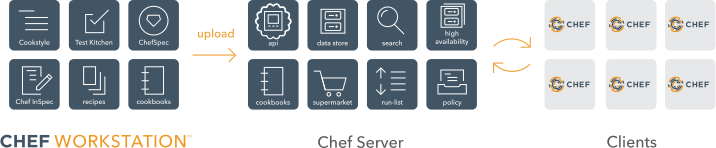
- Chef Workstation is the location where users interact with Chef Infra. With Chef Workstation, users can author and test cookbooks using tools such as Test Kitchen and interact with the Chef Infra Server using the knife and chef command line tools.
- Chef Infra Client Chef Infra Client runs on systems that are managed by Chef Infra. The Chef Infra Client executes on a schedule to configure a system to the desired state.
- Chef Infra Server acts as a hub for configuration data. Chef Infra Server stores cookbooks, the policies that are applied to nodes, and metadata that describes each registered node that’s being managed by Chef. Nodes use the Chef Infra Client to ask the Chef Infra Server for configuration details, such as recipes, templates, and file distributions.
Chef Infra Components
The following diagram shows the relationships between the various elements of Chef Infra, including the nodes, the server, and the workstation. These elements work together to provide the Chef Infra Client the information and instruction that it needs so that it can do its job. As you are reviewing the rest of this topic, use the icons in the tables to refer back to this image.
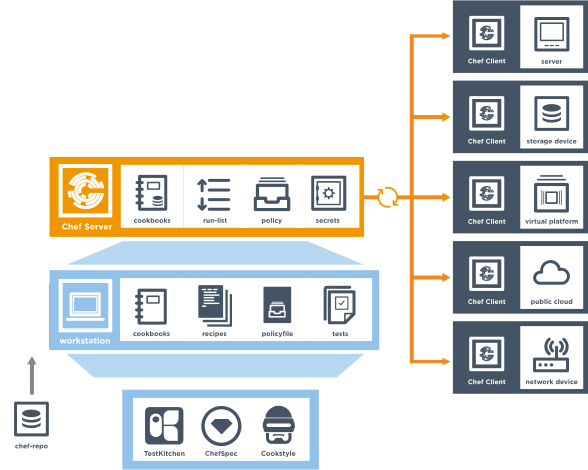
Chef Infra has the following major components:
| Component | Description |
|---|---|
| One (or more) workstations are configured to allow users to author, test, and maintain cookbooks. Workstation systems run the Chef Workstation package which includes tools such as Chef Infra Client, Chef InSpec, Test Kitchen, ChefSpec, Cookstyle, and other tools necessary for developing and testing your infrastructure with Chef products. |
| Cookbooks are uploaded to the Chef Infra Server from these workstations. Some cookbooks are custom to the organization and others are based on community cookbooks available from the Chef Supermarket. |
| Ruby is the programming language that's the authoring syntax for cookbooks. Most recipes are simple patterns (blocks that define properties and values that map to specific configuration items like packages, files, services, templates, and users. The full power of Ruby is available for when you need a programming language. |
| A node is any device—physical, virtual, cloud, network device, etc.—that’s under management by Chef Infra. |
| Chef Infra Client is installed on each node that's managed with Chef Infra. Chef Infra Client configures the node locally by performing the tasks specified in the run-list. Chef Infra Client will also pull down any required configuration data from the Chef Infra Server during a Chef Infra Client run. |
| The Chef Infra Server acts as a hub of information. Cookbooks and policy settings are uploaded to the Chef Infra Server by users from workstations. The Chef Infra Client accesses the Chef Infra Server from the node on which it's installed to get configuration data, performs searches of historical Chef Infra Client run data, and then pulls down the necessary configuration data. After a Chef Infra Client run is finished, the Chef Infra Client uploads updated run data to the Chef Infra Server. |
| Chef Supermarket is the location in which community cookbooks are shared and managed. Cookbooks that are part of the Chef Supermarket may be used by any Chef user. How community cookbooks are used varies from organization to organization. |


Chef Infra Client run reporting, compliance reporting, high availability configurations, and Chef Infra Server replication are available as part of Chef Automate.
The following sections discuss these elements (and their various components) in more detail.
Workstations
A workstation is your local computer running Chef Workstation that you use to author cookbooks, interact with the Chef Infra Server, and interact with nodes.
The workstation is where users do most of their work, including:
- Developing and testing cookbooks
- Keeping the Chef Infra repository synchronized with version source control
- Configuring organizational policy by including defining roles and applying Policyfiles or policy groups
- Interacting with nodes, as (or when) required, such as performing a bootstrap operation
Chef Workstation Components and Tools
Some important tools and components of Chef Workstation include:
| Component | Description |
|---|---|
| Start your infrastructure automation with Chef Workstation. Chef Workstation gives you everything you need to get started with Chef - ad hoc remote execution, remote scanning, configuration tasks, cookbook creation tools as well as robust dependency and testing software - all in one easy-to-install package. Chef Workstation includes:
|
| Chef Workstation includes important command-line tools:
|
| The chef-repo is the repository structure in which cookbooks are authored, tested, and maintained:
The directory structure within the chef-repo varies. Some organizations prefer to keep all of their cookbooks in a single chef-repo, while other organizations prefer to use a chef-repo for every cookbook. |
| Use Test Kitchen to automatically test cookbooks across any combination of platforms and test suites:
|
| Use ChefSpec to simulate the convergence of resources on a node:
|

Cookbooks
A cookbook is the fundamental unit of configuration and policy distribution in Chef Infra.
A cookbook defines a scenario and contains everything that’s required to support that scenario:
- Recipes that specify which Chef Infra built-in resources to use, as well as the order in which they’re to be applied
- Attribute values, which allow environment-based configurations such as
devorproduction. - Custom Resources for extending Chef Infra beyond the built-in resources.
- Files and Templates for distributing information to systems.
- Custom Ohai Plugins for extending system configuration collection beyond the Ohai defaults.
- The
metadata.rbfile, which describes the cookbook itself and any dependencies it may have.
The Chef Infra Client uses Ruby as its reference language for creating cookbooks and defining recipes, with an extended DSL for specific resources. A reasonable set of resources are available to the Chef Infra Client, enough to support many of the most common infrastructure automation scenarios; however, this DSL can also be extended when additional resources and capabilities are required.
Components
Cookbooks are comprised of the following components:
| Component | Description |
|---|---|
| An attribute can be defined in a cookbook (or a recipe) and then used to
override the default settings on a node. When a cookbook is loaded
during a Chef Infra Client run, these attributes are compared to the
attributes that are already present on the node. Attributes that are
defined in attribute files are first loaded according to cookbook order.
For each cookbook, attributes in the default.rb file are loaded first,
and then additional attribute files (if present) are loaded in lexical
sort order. When the cookbook attributes take precedence over the
default attributes, Chef Infra Client applies those new settings and
values during a Chef Infra Client run on the node. |
| Use the cookbook_file resource to transfer files from a
sub-directory of COOKBOOK_NAME/files/ to a specified path located on a
host that’s running Chef Infra Client. The file is selected according
to file specificity, which allows different source files to be used
based on the hostname, host platform (operating system, distro, or as
appropriate), or platform version. Files that are located in the
COOKBOOK_NAME/files/default sub-directory may be used on any platform. |
| A library allows arbitrary Ruby code to be included in a cookbook. The
most common use for libraries is to write helpers that are used
throughout recipes and custom resources. A library file is a Ruby file
that’s located within a cookbook’s /libraries directory. Because a
library is built using Ruby, anything that can be done with Ruby can be
done in a library file, including advanced functionality such as
extending built-in Chef classes. |
| Every cookbook requires a small amount of metadata.
The contents of the A
|
| A recipe is the most fundamental configuration element within the organization. A recipe:
The Chef Infra Client will run a recipe only when asked. When the Chef Infra Client runs the same recipe more than once, the results will be the same system state each time. When a recipe is run against a system, but nothing has changed on either the system or in the recipe, the Chef Infra Client won't change anything. The Chef Infra Language is a comprehensive systems configuration language with resources and helpers for configuring operating systems. The language is primarily used in Chef Infra recipes and custom resources to tell the Chef Infra Client what actions to take to configure a system. The Chef Infra Language provides resources for system-level components such as packages, users, or firewalls, and it also includes helpers to allow you to make configuration decisions based on operating systems, clouds, virtualization hypervisors, and more. |
| A resource is a statement of configuration policy that:
Chef has many built-in resources that cover all of the most common actions across all of the most common platforms. You can build your own resources to handle any situation that's not covered by a built-in resource. |
| A cookbook template is an Embedded Ruby (ERB) template that’s used to dynamically generate static text files. Templates may contain Ruby expressions and statements, and are a great way to manage configuration files. Use the template resource to add cookbook templates to recipes; place the corresponding Embedded Ruby (ERB) template file in a cookbook’s /templates directory. |
| Testing cookbooks improves the quality of those cookbooks by ensuring they're doing what they're supposed to do and that they're authored in a consistent manner. Unit and integration testing validates the recipes in cookbooks. Syntax testing---often called linting---validates the quality of the code itself. The following tools are popular tools used for testing Chef recipes: Test Kitchen, ChefSpec, and Cookstyle. |



Nodes
A node is any device—physical, virtual, cloud, network device, etc.—that’s under management by Chef Infra.Node Types
The types of nodes that can be managed by Chef include, but aren’t limited to, the following:
| Node Type | Description |
|---|---|
| A physical node is typically a server or a virtual machine, but it can be any active device attached to a network that's capable of sending, receiving, and forwarding information over a communications channel. In other words, a physical node is any active device attached to a network that can run a Chef Infra Client and also allow that Chef Infra Client to communicate with a Chef Infra Server. |
| A cloud-based node is hosted in an external cloud-based service, such as Amazon Web Services (AWS), OpenStack, Rackspace, Google Compute Engine, or Microsoft Azure. Plugins are available for knife that provide support for external cloud-based services. knife can use these plugins to create instances on cloud-based services. Once created, Chef Infra Client can be used to deploy, configure, and maintain those instances. |
| A virtual node is a machine that runs only as a software implementation, but otherwise behaves much like a physical machine. |
| A network node is any networking device---a switch, a router---that's being managed by a Chef Infra Client, such as networking devices by Juniper Networks, Arista, Cisco, and F5. Use Chef to automate common network configurations, such as physical and logical Ethernet link properties and VLANs, on these devices. |
| Containers are an approach to virtualization that allows a single operating system to host many working configurations, where each working configuration---a container---is assigned a single responsibility that's isolated from all other responsibilities. Containers are popular as a way to manage distributed and scalable applications and services. |



Chef on Nodes
The key components of nodes that are under management by Chef include:
| Component | Description |
|---|---|
| Chef Infra Client is an agent that runs locally on every node that’s under management by Chef Infra Server. When Chef Infra Client runs, it performs all of the steps required for bringing a node into the expected state, including:
|
| Ohai is a tool for collecting system configuration data, which it then provides to Chef Infra Client to use in cookbooks. Chef Infra Client runs Ohai at the start of every Chef Infra run to determine system state. The attributes that Ohai collects are called The types of attributes Ohai collects include but aren’t limited to:
Ohai includes required and optional plugins to detect common configuration information. Ohai has a plugin model and language to write custom plugins to collect additional system state information. |
The Chef Infra Server
The Chef Infra Server acts as a hub for configuration data. The Chef Infra Server stores cookbooks, the policies that are applied to nodes, and the metadata that describes each registered node that is under management by Chef Infra Client. Nodes use Chef Infra Client to ask the Chef Infra Server for configuration details, such as recipes, templates, and file distributions. Chef Infra Client then does as much of the configuration work as possible on the nodes themselves (and not on the Chef Infra Server). This scalable approach distributes the configuration effort throughout the organization.| Feature | Description |
|---|---|
| Search indexes allow queries to be made for any type of data that’s
indexed by the Chef Infra Server, including data bags (and data bag
items), environments, nodes, and roles. A defined query syntax is used
to support search patterns like exact, wildcard, range, and fuzzy. A
search is a full-text query that can be done from several locations,
including from within a recipe, by using the search subcommand in
knife, the search method in the Chef Infra Language, the search box in the Chef
management console, and by using the /search or /search/INDEX
endpoints in the Chef Infra Server API. The search engine is based on
Elasticsearch and is run from the Chef Infra Server. |
| Chef management console is a web-based interface for the Chef Infra Server that provides users a way to manage the following objects:
|
| Data bags store global variables as JSON data. Data bags are indexed for searching and can be loaded by a cookbook or accessed during a search. |
| Policy defines how business and operational requirements, processes, and production workflows map to objects that are stored on the Chef Infra Server. Policy objects on the Chef Infra Server include roles, environments, and cookbook versions. |



Policy
Policy maps business and operational requirements, process, and workflow to the following settings and objects stored on the Chef Infra Server:
- Roles define server types, such as “web server” or “database server”.
- Environments define process, such as “dev”, “staging”, or “production”.
- Attributes define environment-specific details about a node that are included in a Policyfile.
- Certain types of data—passwords, user account data, and other sensitive items—can be placed in data bags, which are located in a secure sub-area on the Chef Infra Server that can only be accessed by nodes that authenticate to the Chef Infra Server with the correct SSL certificates.
- The cookbooks (and cookbook versions) in which organization-specific configuration policies are maintained.
Some important aspects of policy include:
| Feature | Description |
|---|---|
| A role is a way to define certain patterns and processes that exist across nodes in an organization as belonging to a single job function. Each role consists of zero (or more) attributes and a run-list. Each node can have zero (or more) roles assigned to it. When a role is run against a node, the configuration details of that node are compared against the attributes of the role, and then the contents of that role’s run-list are applied to the node’s configuration details. When a Chef Infra Client runs, it merges its own attributes and run-lists with those contained within each assigned role. |
| An environment is a way to map an organization’s real-life workflow to what can be configured and managed when using Chef Infra. This mapping is accomplished by setting attributes and pinning cookbooks at the environment level. With environments, you can change cookbook configurations depending on the system’s designation. For example, by designating different staging and production environments, you can then define the correct URL of a database server for each environment. Environments also allow organizations to move new cookbook releases from staging to production with confidence by stepping releases through testing environments before entering production. |
| A cookbook version represents a set of functionality that’s different from the cookbook on which it’s based. A version may exist for many reasons, such as ensuring the correct use of a third-party component, updating a bug fix, or adding an improvement. A cookbook version is defined using syntax and operators, may be associated with environments, cookbook metadata, and/or run-lists, and may be frozen (to prevent unwanted updates from being made). A cookbook version is maintained just like a cookbook, with regard to source control, uploading it to the Chef Infra Server, and how Chef Infra Client applies that cookbook when configuring nodes. |
| A run-list defines all of the information necessary for Chef to configure a node into the desired state. A run-list is:
|


Conclusion
Chef is a thin DSL (domain-specific language) built on top of Ruby. This approach allows Chef to provide just enough abstraction to make reasoning about your infrastructure easy. Chef includes a built-in taxonomy of all the basic resources one might configure on a system, plus a defined mechanism to extend that taxonomy using the full power of the Ruby language. Chef chose Ruby because it provides the flexibility to use both the simple built-in taxonomy, as well as being able to handle any customization path your organization requires.